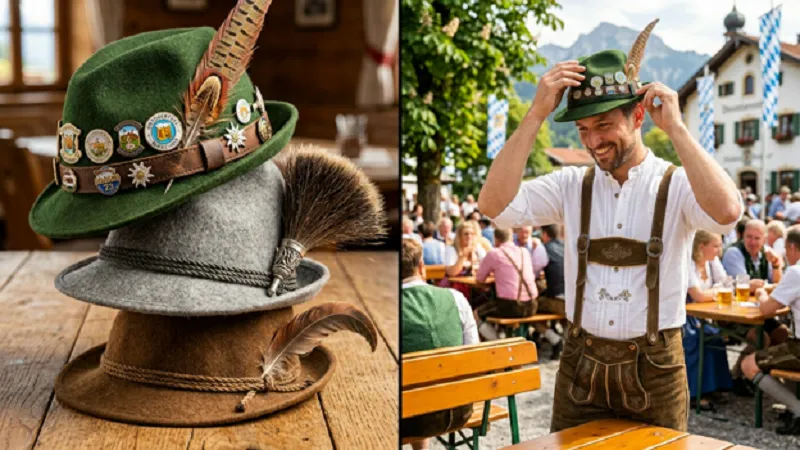
Every traditional outfit has a finishing move, and Bavaria’s happens above the hairline. The oktoberfest hat — the felted, corded, feathered Bavarian hat in its several classic forms — is the piece that completes the festival silhouette, carries the tradition’s most charming customs (the pins, the badges, the famous shaving-brush plume), and separates the finished outfit from the almost-finished one in every tent photograph. It’s also the most under-explained piece in the wardrobe: which hat style, which decorations, what the customs actually mean, and how the crown coordinates with everything below it. This guide answers all of it — the styles, the feather-and-pin culture, the pairing rules, the quality screen, and the wearing conventions that put the hat on right.
The Bavarian Hat Styles
The tradition runs on a short list of classic forms. The Trachtenhut: the standard Bavarian felt hat — shaped crown, modest brim, decorative cord at the base — in loden green, grey and brown; the default festival hat and the correct first purchase. The Tyrolean (Alpine) hat: the pointed-crown, narrow-brimmed silhouette the world pictures — same felt family, sharper profile, shared across the Bavarian-Austrian arc. The Seppelhut: the softer, rounder folk variant with its own rustic charm. And the specialty crowns: hunters’ hats with full plumage, formal dress hats for ceremony, and straw summer versions for beer-garden season.
Material defines the tier throughout: genuine wool felt — structured, matte, weather-shrugging — against the costume aisle’s stiff synthetic imitations, with the felt’s quality readable in the crown’s shape-holding and the finish’s depth.
The Feather, the Brush and the Pins
The hat’s crown-side culture is the tradition’s most collectible corner. The Gamsbart — the famous “chamois beard” shaving-brush plume — is the summit decoration: a groomed tuft of chamois (or goat) hair in a metal socket, historically a hunter’s trophy and status marker, sized from modest tufts to the magnificent brushes serious Trachten wearers display. Feathers — pheasant, rooster, eagle-style — are the accessible classic, worn on the hat’s left side by convention. And the pins: the Bavarian hat’s living scrapbook — enamel badges from festivals, towns, clubs and years, accumulated across a wearer’s Oktoberfest life until the hatband reads like a passport.
The pin custom is the beginner’s easiest entry: start collecting at your first festival, add one from every event after, and within a few seasons the hat carries a history no store can sell — which is precisely the tradition’s point.
Pairing the Crown: Lederhosen and Hat as a System
The hat coordinates downward by the outfit’s standing palette rules. Color: loden green and grey felt pair with every leather tone (the green hat over brown lederhosen and hat tradition being the classic combination); brown felt matches warm builds; the hat’s cord and the outfit’s greens echo naturally. Register: the standard Trachtenhut serves festival through smart; full-plume hunters’ hats read formal-traditional; straw versions stay casual-summer. Proportion: modest brims suit most faces and the festival’s practical realities — the hat should frame, not stage.
The system rule that finishes the look: the hat joins an outfit already coordinated — leather, shirt, suspenders and socks in the traditional order — as the final echo, typically picking up the green thread (cord, feather, sock flashes) that runs through the whole Alpine palette.
The Quality Screen and the Fit
Buying runs the tradition’s usual screen at hat scale. Material: wool felt named — the synthetic costume tier stiffens, shines and collapses at the first drizzle. Construction: shaped (blocked) crowns that hold form, finished brims, real cord bands, and a socket or band ready for decorations. Fit: sized by head circumference measured above the brows — snug enough to hold through a festival day’s enthusiasm, never gripping; between sizes, the larger with a felt’s natural conforming. And the decoration hardware: feather sockets and pin-friendly bands on the quality tier, glued-on ornaments on the other one.
Care is felt-simple: brush with the nap, rest on the crown or a hook (never brim-flat long-term), let rain dry naturally, and reshape the crown’s dents by hand — a quality felt takes decades of festivals exactly this way.
Wearing It Right: The Conventions
The hat’s conventions are few and worth keeping. Wear it level or barely tilted — the jaunty extreme reads costume. Decorations ride the left side by custom; the Gamsbart points upright from its socket. Indoors etiquette follows the room: hats stay on in the beer tent’s festival chaos, come off for anthems, ceremonies and photographs where elders remove theirs — reading the room being itself the convention. And the hat stays with the register it joined: the felt crown belongs to the traditional build; over street-modern leather styling it reads as the half-tradition every register refuses.
Kept simply, the conventions do what conventions exist for: they let the hat read fluent — the finishing move executed by someone who knew there was one.
Frequently Asked Questions
What is the traditional Oktoberfest hat called?
The Trachtenhut — Bavaria’s felt hat with corded band — with the pointed Tyrolean profile as the famous Alpine variant.
What’s the brush-like plume on Bavarian hats?
The Gamsbart: a groomed chamois-hair tuft in a metal socket — historically a hunter’s trophy, now the tradition’s premier hat decoration.
Which side do feathers and pins go on?
The left, by convention — feathers in the band or socket, pins accumulating along the hatband as a personal festival record.
What color hat goes with lederhosen?
Loden green and grey pair with every leather tone — the green-felt-over-brown-leather combination is the tradition’s classic.
How should a Bavarian hat fit?
Snug by head circumference measured above the brows — secure through a festival day, never gripping, with felt conforming over the first wears.
Do you wear the hat indoors at Oktoberfest?
In the tents’ festival atmosphere, yes — removed for anthems, ceremonies and wherever the room’s elders remove theirs.