IN SHORT
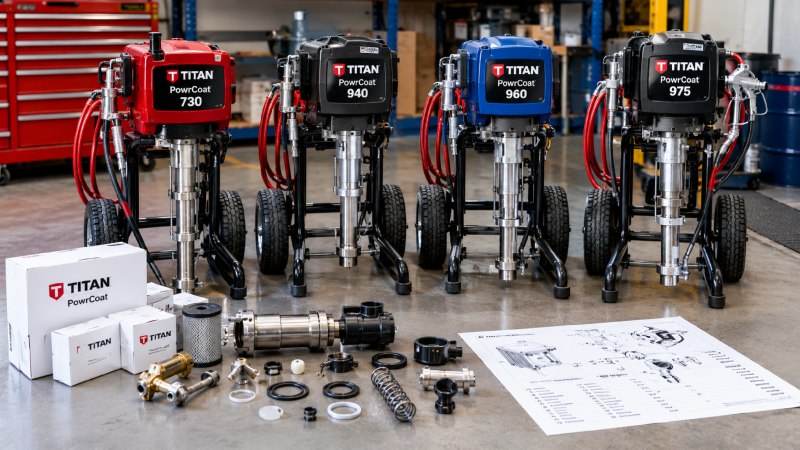
The Titan PowrCoat 730, 940, 960, and 975 are different air-powered pumps matched to different output requirements. The 940, 960, and 975 share a common 900-series air motor and many service parts, while the 730 uses its own assembly. Matching parts requires confirming your exact model against its diagram, because part numbers are model-specific.
One Family, Several Machines
The Titan PowrCoat name covers a range of air-powered pumps, and contractors servicing them often assume the numbers work like a simple scale where bigger means the same parts, just larger. They do not. The 730, 940, 960, and 975 are genuinely different machines with different output ratings, and while some share components, others do not. Ordering the wrong part because two models looked similar is the most common mistake on this range, and it is entirely avoidable.
Understanding how the models relate — where they share parts and where they diverge — makes ordering reliable. The full range and its subcategories are organized in the powrcoat parts catalog, which separates each model so you can work from your exact machine rather than guessing across the family.
The PowrCoat 730
The PowrCoat 730 sits at the smaller end of the range. It is a capable air-powered pump for industrial coating, but it is built on its own air motor assembly, distinct from the larger 900-series machines. Its air motor parts and fluid pump components are specific to the 730, and they do not generally interchange with the 940, 960, or 975.
This is the first and most important distinction to internalize: the 730 is not a smaller 960. It is its own machine. When you service a 730, work from the 730’s diagrams specifically, not from a larger model that happens to look similar. Treating it as part of the 900-series is exactly how wrong orders happen.
The 900-Series: PowrCoat 940, 960, and 975
The 940, 960, and 975 are closely related. They share a common 900-series air motor, and Titan’s own documentation confirms that the same air motor assembly serves all three models in both cart and wall configurations. This is why their air motor service kits — both the minor and the major — cover all three machines together.
Where they differ is output. Each model is rated for a different pressure ratio and maximum fluid pressure, matched to different coating demands. The 960, for example, runs a 60:1 pressure ratio with a 6,000 PSI maximum fluid pressure and a 100 PSI maximum air inlet. The 940 and 975 carry their own ratings. So while they share the air motor, the fluid pump side is matched to each model’s output, and fluid pump parts are model-specific even within the 900-series.
Where Parts Cross and Where They Do Not
The practical map for this range comes down to a few clear rules.
- Air motor service parts — the minor and major kits, valve components, and seals — are shared across the 940, 960, and 975 because they use the common 900-series air motor.
- The PowrCoat 730 uses its own air motor and does not share these parts with the 900-series.
- Fluid pump parts — packings, foot valves, displacement rods — are matched to each model’s output and are model-specific.
- Many small components — certain O-rings, foot valve balls, and fasteners — appear across multiple models, but only confirmation against the diagram makes that certain.
The lesson is that sharing happens on the air motor side within the 900-series, but the fluid pump side and the entire 730 stand apart. Never assume a fluid pump part crosses between models even within the 900-series without checking.
How to Order the Right Part
Given the mix of shared and model-specific parts, the ordering sequence matters more here than on a single-model machine.
- Identify your exact PowrCoat model — 730, 940, 960, or 975 — from the machine, not from memory.
- Determine whether your part is an air motor component or a fluid pump component.
- For 900-series air motor parts, the shared kits apply; for fluid pump parts, use your specific model’s diagram.
- Confirm your model appears in the fitment note before ordering.
Because the machines carry model codes — the 960 as 0533960C and 0533960W, the 940 and 975 with their own codes — matching that code to the diagram removes any ambiguity. When a part is shared, the diagram will show it fitting multiple models; when it is specific, the diagram confines it to yours.
Understanding the Model Codes
One practical detail makes ordering across the PowrCoat range far more reliable: the full model codes. Each PowrCoat carries a code that specifies not just the model but the configuration, and reading it correctly removes most ambiguity. The 960, for example, appears as 0533960C in its cart configuration and 0533960W in its wall configuration. The 940 and 975 carry their own codes with the same C and W convention for cart and wall.
These codes matter because configuration affects some parts. A cart machine and a wall machine of the same model share the pump and air motor, but their mounting and frame components differ. Working from the full code — rather than just the model number — tells you and the supplier exactly which configuration’s parts you need, which matters most for the frame, cart, and mounting components.
When you order, quote the full model code from the machine’s data plate. It resolves the cart-versus-wall question automatically, and it gives the supplier the information needed to confirm fitment against the correct diagram. For a fleet that mixes configurations, recording each machine’s full code in a parts reference turns an otherwise error-prone ordering process into a simple lookup, and it is the single most useful piece of information to have on hand before calling in an order.
Servicing Across a Mixed PowrCoat Fleet
An operation running more than one PowrCoat benefits from understanding this structure. If you run a 940 and a 975, you can stock a single set of 900-series air motor service kits that covers both, which reduces inventory. But you must stock fluid pump parts — packings especially — for each model separately, because those do not cross.
If you also run a 730, treat it as a separate parts line entirely. Its air motor and fluid pump parts are its own. Building a per-model parts reference, with the shared 900-series air motor items noted as common, turns this from a confusing range into a manageable one. Confirm each part against the machine’s diagram, and the fitment notes make the shared-versus-specific distinction explicit.
Frequently Asked Questions
Do PowrCoat 940, 960, and 975 use the same parts?
They share a common 900-series air motor, so air motor service kits and valve components cross all three. Their fluid pump parts, however, are matched to each model’s output rating and are model-specific, so packings and foot valves should be confirmed per model.
Are PowrCoat 730 parts the same as the 940, 960, or 975?
No. The PowrCoat 730 uses its own air motor and fluid pump assemblies, distinct from the 900-series. Its parts do not generally interchange with the larger models, so it should be treated as a separate parts line.
What is the difference between the PowrCoat 940, 960, and 975?
They share the 900-series air motor but differ in output. Each is rated for a different pressure ratio and maximum fluid pressure — for example the 960 runs a 60:1 ratio at 6,000 PSI maximum — matched to different coating demands.
How do I order the correct PowrCoat part?
Identify your exact model, determine whether the part is an air motor or fluid pump component, then confirm it against that model’s diagram. Air motor parts are shared across the 900-series, while fluid pump parts are model-specific.
About the Author
Nnanna Otuonye is the founder and CEO of AllTitanParts.com, an authorized OEM dealer for Titan, SprayTech, Wagner, and Speeflo spray equipment, located at 5250 Gulfton St, Suite 1H, Houston, Texas 77081. With over 20 years in the spray equipment industry, he supplies painting contractors and industrial coating professionals across the United States with genuine factory parts and same-day shipping on orders placed before 3PM CST.