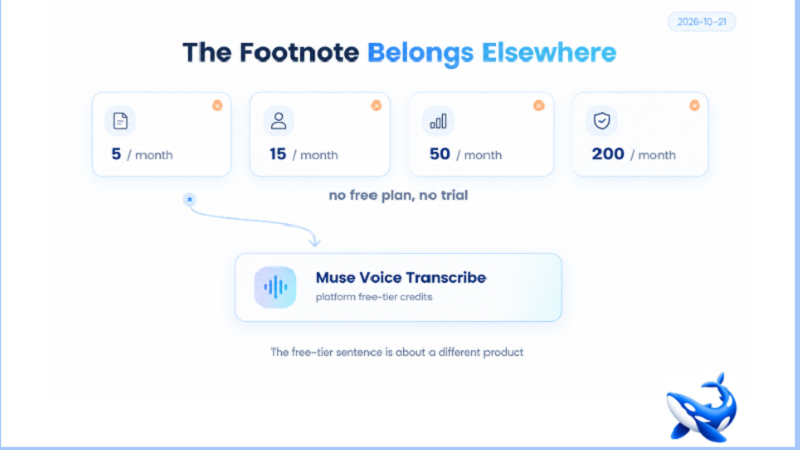
The most-asked commercial question about Muse Code is whether it has a free tier, and the answer on the OrcaRouter muse code reference page is one word:
The vendor’s product page, subscriptions page and changelog were re-read together on 2026-10-14 and contain no free plan, no trial, no free credit allocation and no rate-limited gratis access. The four plans are $5, $15, $50 and $200 a month, and the token billing on the vendor’s model API is separate: $1.25 per million input and $4.25 per million output on the Standard tier.
There is one sentence in the vendor’s documentation that reads like a free tier, and it is the reason this article exists. It says that platform free-tier credits apply — in a note about Muse Voice Transcribe, a separate product on the same platform with per-hour billing. Quoted on its own, that clause looks like an answer about Muse Code. It is not; it is about transcription pricing, and the two products do not share a billing policy.
What Muse Code actually is
It is not a model. It is a harness: a terminal and CI coding agent built for the Muse Spark family, which you run inside a project directory and which plans, edits files and runs commands, with approvals and an OS sandbox active from the first run.
The vendor frames Muse Code and the model API as two routes to the same underlying model: call the API directly when building your own agent, run Muse Code when you want a ready-made one at the command line or in a pipeline. That distinction matters for pricing, because the subscription buys the harness and the API key is billed separately per token.
So the correct statement of the cost is not “$5 a month” or “$1.25 per million tokens”. It is “one of these, plus the tokens you actually burn”, and the token half is what scales with usage.
The version question that changes what you are paying for
Muse Code runs on Muse Spark, and which Muse Spark matters for the price you are paying a subscription to reach.
Muse Spark 1.3 is the current generation, dated 2026-09-02. Muse Spark 1.2 is what the CLI still selects unless you tell it otherwise. Muse Spark 1.1 is still served on the same tier at the same rates [VENDOR].
Three generations, one subscription, one rate card. The subscription does not buy you a model; it buys you the harness, and the model is whatever the CLI selects. That is why the version question is a pricing question in disguise: a team paying $50 a month to run the current generation may be running the previous one and not know it.
There are two ways to check. `muse –version` reports the CLI version, and the model selection is a separate setting — the CLI’s default is 1.2, and 1.3 has to be named.
The installation surface, and why it is on a pricing page
Two vendor surfaces do not quite agree on the install string, which is a small thing that costs a support ticket:
- macOS and Linux: `curl -fsSL https://dev.meta.ai/install.sh | sh` on the docs page, and the same command ending `| bash` on the marketing page and in both research blog posts.
- Windows: `irm https://dev.meta.ai/install.ps1 | iex`, published on the docs page only.
Verification is `muse –version`, then `muse` in a project directory for an interactive session. The first run asks you to trust the workspace — which is what loads its skills, rules and hooks — and to authenticate by browser sign-in or with an API key; in CI you set `META_API_KEY` instead.
Two front ends matter for billing. `muse` runs the interactive terminal UI and `muse exec “<prompt>”` runs a single non-interactive pass to completion. A CI pipeline that runs `muse exec` on every pull request is generating API-billed tokens continuously, and the subscription is only the entry fee.
That is the shape of the cost that a plan comparison misses: the harness is a fixed monthly charge, and every push triggers work that bills per token.
Why the harness is a versioned interface and not just a CLI
One detail in the vendor’s material is easy to skip and worth a paragraph, because it changes what “the product” is.
`muse serve` runs a versioned session protocol, `muse schema` prints its JSON schema, and `npm install @muse-code/sdk` installs a TypeScript wrapper. The changelog shows the protocol being extended deliberately: sessions can be renamed over the protocol, clients can read a structured diff summary for each edit, and a driving program can set a session-wide reasoning-effort default.
That means Muse Code is not only an interactive tool you install and use. It is a headless service you can drive from your own program, which is the mode in which the fixed subscription and the variable token bill separate furthest — a service running thousands of sessions a month on a $50 seat is a different economic object from a developer typing at a terminal.
The token rate behind the free-tier question
Since the free-tier question is really a cost question, here is the number that answers it.
The Standard tier runs at $1.25 per million input tokens and $4.25 per million output [VENDOR]. On the OrcaRouter Meta provider page, the same two Muse Spark models appear at exactly those rates, passed through with $0 markup, with a $0.150 cached rate and a 1M context window [OURS].
A `muse exec` pass on a modest change — say a 30,000-token context of files and diff, and 3,000 tokens of output:
- Input: 30,000 × $1.25 ÷ 1,000,000 = $0.0375.
- Output: 3,000 × $4.25 ÷ 1,000,000 = $0.01275.
- Total: about $0.05 per pass [OURS arithmetic on VENDOR rates].
A hundred passes a day is $5 a day, or about $150 a month on top of the subscription. Two hundred a day doubles it. The subscription’s $50 tier is thus a small fraction of the real monthly cost for any active CI usage, and a plan comparison that lists only the plans understates it by a wide margin.
That is the practical answer to “is there a free tier”: the tier is not the product’s cost anyway. The tokens are.
How to evaluate the plans
Four questions, in the order that matters.
What does the plan actually unlock? The four tiers at $5, $15, $50 and $200 gate usage limits on the harness, not on the model. The model bills the same at every tier.
How many passes will CI run? Each `muse exec` invocation is a billed request. A pipeline that fires on every push multiplies a small per-pass cost by the number of pushes, and that product is usually the largest line in the budget.
Which Muse Spark is the CLI selecting? The default is 1.2 and the current generation is 1.3. A team that has not set it explicitly is paying for the harness and running the previous model.
Where did the free-tier claim come from? If it traces to a sentence about platform credits, check which product that sentence is attached to. On this vendor’s documentation, the one sentence of that shape belongs to a transcription product, not to the coding agent.
No free tier is not the same as no cheap way in. The cheapest legitimate entry is the lowest subscription tier plus a small token bill, and the token bill is the part that decides whether the whole arrangement is economical.