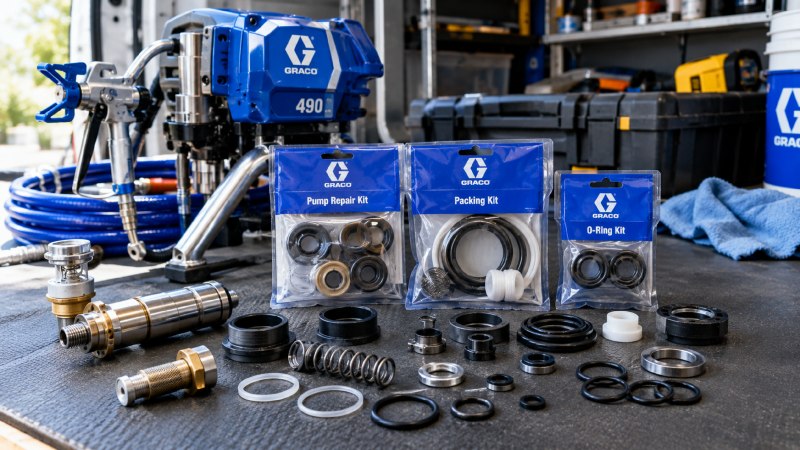
Ask an experienced painter what actually stops work on a job site, and it is rarely the big, dramatic failure. Motors do not usually just die. Pumps do not typically seize without warning. What actually costs a day of work is almost always something small: a worn seal that starts leaking paint, an O ring that has finally given out after months of exposure to solvents, a packing that no longer holds pressure the way it used to.
These parts cost a few dollars each. The downtime they cause when you do not have a spare on hand costs a lot more. This is why experienced crews keep a small stock of the most common wear parts on the truck instead of treating every failure as a trip to order something new.
Why These Parts Fail First
O rings and packings do a simple job under difficult conditions. They create a seal between moving parts, and they do it while constantly exposed to paint, thinner, and the friction of a piston moving thousands of times over the course of a job. Rubber and synthetic seal materials degrade from that exposure over time, even with proper care, which means failure is not really a question of if, it is a question of when.
This is different from a genuine mechanical failure, like a cracked housing or a seized bearing, which usually points to a bigger underlying problem. Seal wear is expected, normal, and predictable, which is exactly why it makes sense to plan for it instead of being surprised by it every time.
The Parts Worth Carrying
A small, well chosen kit covers most of what actually goes wrong on a job site. The Graco 16Y425 O ring, used across several handheld and TrueCoat sprayer models, is a genuinely common point of failure since these smaller units cycle through seals faster relative to their size than larger contractor machines. Keeping a couple of these on hand means a leak that would otherwise end a job early becomes a five minute fix instead.
Pump packing kits are the other essential item. These kits contain the seals that keep the pump itself from leaking around the piston, and they wear from the same friction and solvent exposure described above. A packing kit that fits your specific pump family is worth having before you need it, not after, since a pump that is actively leaking paint or thinner is not something you want to keep running while you wait for a part to ship.
Prime and drain valve kits round out a reasonable truck stock for anyone running a sprayer regularly. These valves see constant use every time you prime the pump or switch materials, and the seals inside them wear at a predictable rate tied directly to how often the sprayer gets used.
What a Failure Actually Looks Like
It helps to know what you are watching for before it becomes an obvious problem. A worn O ring or packing usually shows up first as a small amount of paint or fluid appearing somewhere it should not, often around the pump housing or a fitting that was not leaking before. It is easy to wipe this away and keep working the first time you notice it, but a seal that has started leaking rarely gets better on its own, and the leak typically gets worse as the job continues.
Pressure inconsistency is the other common sign. A pump that used to hold steady pressure but now surges or drops slightly under load is sometimes a seal issue rather than a bigger mechanical one, especially if the change happened gradually rather than all at once.
Catching either of these early, before the seal fails completely mid job, is exactly what a truck stock of common parts is for.
Why This Is Cheaper Than It Sounds
There is sometimes a hesitation to keep spare parts on hand because it feels like spending money on something you might not need. It is worth reframing that. A single graco 16y425 o ring costs a small fraction of what a single lost work day costs, whether that lost day comes from driving to source a part locally or from waiting on standard shipping mid job. Buying a couple of these proactively is closer to an insurance cost than a real expense, and it pays for itself the first time it prevents a delay.
The same logic applies to broader graco pump repair kits, which bundle several of the most common wear parts for a given pump family into a single kit. Buying the kit ahead of a failure, rather than piecing together individual parts after something has already gone wrong, is usually both cheaper and faster.
Building a Reasonable Stock Without Overdoing It
You do not need a full parts room in the back of a truck. A reasonable starting stock covers the seals specific to whichever machine or machines you actually run, plus a general packing kit sized to your most used pump. If you run more than one type of sprayer across different jobs, it is worth keeping a small labeled kit for each rather than one mixed bag of parts you have to sort through under time pressure.
Replacing these items in your stock as you use them, rather than waiting until you are completely out, keeps you from ever being caught without a spare on the one day you actually need it.
A Habit Worth Building
The crews who rarely lose a day to a seal failure are not running newer or better maintained machines than everyone else. They have just built a habit of checking wear parts between jobs rather than waiting for a failure to force the issue. A quick look at the pump housing for any sign of dampness, a check of how the prime valve feels compared to when it was new, takes a couple of minutes and usually happens naturally while cleaning the machine at the end of a job anyway.
This habit matters more the busier your schedule gets. A sprayer sitting idle for long stretches between uses tends to fail less predictably, since seals can dry out during storage as easily as they wear out from use. A machine running several days a week, by contrast, follows a much more predictable wear curve, which makes it easier to plan replacements before a failure actually happens rather than reacting to one.
The Takeaway
The parts that cause the most lost time on a paint job are rarely the expensive ones. They are the small seals and packings that wear out from ordinary use and eventually need replacing on a predictable schedule. Keeping a modest stock of these parts on hand, matched to the machines you actually run, is one of the simplest ways to keep a small, expected repair from turning into an unplanned day off the job. It is a small habit with an outsized payoff, and it separates a crew that treats equipment maintenance as routine from one that only thinks about it after something has already gone wrong.