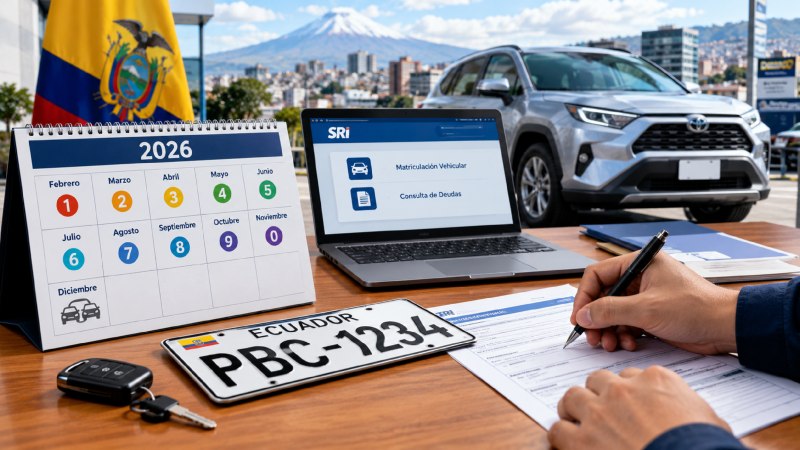
Every year, the same thing happens: your license plate month passes almost without you noticing, and by the time you remember, you already have surcharges to pay. Vehicle registration in Ecuador follows a calendar, and the calendar does not forgive oversights. In 2026, the process started in February with license plates ending in 1 and advances one digit per month until November, with December reserved for those who are behind, who must pay surcharges.
In this guide, I explain how to read that calendar, what fines apply if you are late, how to register a new vehicle for the first time, the correct order of payments, and what to do if your deadline has already passed.
How Vehicle Registration Works in Ecuador
matriculación vehicular is the annual procedure through which you renew the Annual Circulation Permit, the document that authorizes your vehicle to travel on the roads. It is not a single payment but a series of connected steps:
- Pay the registration fees and vehicle tax shown by the SRI.
- Pay local fees (road tax, provincial Road Fund, and other charges depending on the city).
- Pay any outstanding fines from the ANT or municipal authority.
- Pass the Vehicle Technical Inspection (RTV).
- Collect your registration document.
The system follows a calender to avoid overcrowding, authorities distribute vehicle owners according to the last digit of their license plate. In Quito alone, for example, more than 500,000 vehicles must complete the procedure, served by six inspection centers, so without a calendar the system would collapse.
2026 Calendar by Last License Plate Digit
The schedule followed by Quito and Guayaquil for private vehicles in 2026 is as follows:
| Month | Required License Plates Ending In |
| January | Vehicles overdue from the previous year and early registrations |
| February | 1 |
| March | 2 |
| April | 3 |
| May | 4 |
| June | 5 |
| July | 6 |
| August | 7 |
| September | 8 |
| October | 9 |
| November | 0 |
| December | All overdue license plates, with surcharges |
Important: The calendar may vary in certain details depending on the canton. Guides from other provinces, such as Imbabura, publish a different schedule, with digit 1 assigned to January, for example. Before assuming your registration month, always confirm it on the website of your city’s traffic authority.
How to read it: If your license plate ends in 4, your month is May. You have the entire month to complete the procedure without a scheduling surcharge. It does not mean “starting in May”; it means “during May.”
Mandatory License Plate vs. Optional License Plate
In Quito, the AMT also publishes an optional license plate column. It works as follows: during each month, vehicles with the mandatory digit must be registered, while those with the next digit can register early if they prefer. For example, in May, plates ending in 4 are mandatory and those ending in 5 are optional.
Why register early?
- Avoid the busiest weeks. The final days of the assigned month tend to overcrowd the centers.
- Give yourself extra time. If you fail the RTV, you have time to fix the issues without moving into the following month.
- Clear the task from your list. The closer you get to the deadline, the greater the risk of missing it.
Note: Optional registration is a convenience, not a guaranteed right in every city. Verify that your locality offers it before planning your appointment.
Surcharges and Fines for Registering After the Deadline
This is where carelessness becomes expensive. According to media reports covering the 2026 calendar, the most common penalties are:
- USD 25 for scheduling, when you register outside your assigned month.
- USD 50 for failing to attend or pass the technical inspection within the deadline.
- USD 25 for the annual registration surcharge, which is added when the delay extends into December.
These amounts accumulate. Anyone who leaves everything until December can regularize their registration, but they must pay all accumulated surcharges.
Driving without a valid registration is another matter. Reference guides indicate fines ranging from USD 200 to USD 400 and possible vehicle impoundment, along with other consequences depending on the case. The exact amounts depend on the recorded violation and current regulations, so check your situation on the official portal before assuming an amount.
Why this matters: Paying $25 for being late is frustrating, but driving with expired registration is much more expensive. A reminder can help you avoid the surcharge; the fine for driving without valid registration is a different risk.
The Correct Order of Payments
Many drivers lose appointment slots because they pay in the wrong order. This sequence helps prevent rejections:
Step 1: Check Your Fees with the SRI
Using your license plate, or the RAMV (for imported vehicles) or CPN (for vehicles assembled in the country), check the registration fee and vehicle ownership tax.
Step 2: Pay the Registration Fee and Tax
You can do this at your financial institution’s counter or through online banking.
Step 3: Check and Pay Local Authority Fees
In Quito, the AMT charges for the Vehicle Technical Inspection and road tax, in addition to the Pichincha Road Fund fee. In Guayaquil, the ATM has its own system. Each canton has its own charges, so check the requirements for yours.
Step 4: Settle Outstanding Fines
Any outstanding fine, whether from the ANT or a municipal authority, blocks the procedure. Paying it beforehand helps prevent rejection on the day of your appointment.
Step 5: Schedule Your RTV Appointment
The system allows you to book only after everything has been paid.
Step 6: Attend, Pass the Inspection, and Collect Your Registration
The RTV must be completed in person. Collecting the registration document also requires an in-person visit.
How to Schedule Your Technical Inspection and Registration Appointment
Step 1: Visit Your Traffic Authority’s Portal
Use the AMT portal in Quito, the ATM portal in Guayaquil, or the portal of your city’s GAD or municipal association.
Step 2: Select the Technical Inspection and Registration Service
Choose your vehicle type (private vehicle, commercial vehicle, or motorcycle).
Step 3: Choose the Center, Date, and Time
If your assigned month is the current month, prioritize the first few weeks.
Step 4: Save Your Confirmation
Print it or keep a screenshot available; the inspection center will ask for it.
Step 5: Arrive Early
Your vehicle must be ready for inspection: lights, brakes, tires, windshield, and fluid levels should all be in good condition.
First-Time Registration of a New Vehicle
First-time registration is different from annual renewal. There is no previous permit to renew, so the process starts from scratch.
Step 1: Gather Your Purchase Documents
You need the vehicle purchase invoice and your ID or RUC. If your vehicle was imported or assembled, you will have a RAMV or CPN to identify it in the system before a license plate exists.
Step 2: Pay the First Registration Fees
These include the authorization document or its equivalent and the applicable taxes. Some reference guides put the authorization document for a new vehicle at around USD 68, but confirm the current amount on the official portal because fees are updated.
Step 3: Complete the Procedure with the Competent Authority
The ANT or an authorized local traffic authority assigns the license plate number and issues the first registration document.
Step 4: Note Your Registration Month for Future Years
Starting with your first renewal, your assigned month will be determined by the last digit of your new license plate. Add it to your calendar.
Note: The dealership usually handles part of this initial registration. Ask exactly what its service includes to avoid duplicate payments.
Differences Between Quito, Guayaquil, and Other Cities
Although the national digit-based system is similar, the process varies depending on where your vehicle is registered.
Quito (AMT): Uses a calendar with mandatory and optional license plates, six inspection centers, and its own charges, such as road tax and the Pichincha Road Fund fee.
Guayaquil (ATM): Follows the national digit-based system and has its own RTV calendar for private vehicles. Some sources mention additional windows for certain digits, so check the ATM’s current announcement.
Other provinces and cantons: Operate through GADs, municipal associations, or the ANT itself. Calendars, inspection centers, and fees may differ. One example is Imbabura, where local guides publish a different monthly schedule.
Why this matters: Copying another city’s calendar is one of the most common causes of avoidable fines. Always confirm with the authority of the city where your vehicle is registered.
What to Do If You Are Already Late
If your assigned month has passed, do not keep waiting. The surcharge will not disappear, and driving in that condition exposes you to more serious penalties.
Step 1: Confirm How Much You Owe
Check your license plate through the SRI and your local authority’s portal. The system will show the registration fee, surcharges, and any fines.
Step 2: Prioritize Settling Everything Together
The longer you wait, the more complicated it becomes to organize your payments.
Step 3: Treat December as a Deadline, Not a Plan
December accommodates overdue vehicles, but with all accumulated surcharges. Use it only if you genuinely could not register earlier.
Step 4: If You Have a Large Fine, Ask About Payment Facilities
The ANT provides installment payments for fines exceeding one basic salary, with an initial payment and installments for the remaining balance. Confirm the current conditions before applying.
Step 5: Do Not Drive While You Regularize Your Registration
If your vehicle does not have valid registration, every trip carries the risk of a fine and impoundment.
Summary Table: What to Do Based on Your Situation
| Your Situation | What You Should Do | What You Avoid |
| Your assigned month is the current month | Pay in the correct order and schedule the RTV as soon as possible | Scheduling surcharge |
| Your assigned month is next month | Consider registering early if your city offers optional registration | End-of-month congestion |
| Your assigned month has passed | Check the amounts, pay everything, and register immediately | Surcharges accumulating until December |
| New vehicle | Complete first-time registration and note your future month | Duplicate payments through the dealership |
| You failed the RTV | Fix the problems and return for inspection within the deadline | Fine for failing to pass the inspection |
Common Mistakes That Delay the Procedure
Paying the registration fee but forgetting outstanding fines. The system blocks the appointment until everything has been paid.
Relying on another city’s calendar. Each authority publishes its own schedule.
Arriving at the RTV without checking the vehicle. Burned-out lights or worn tires are common reasons for failing. A preliminary check with your mechanic costs less than repeating the inspection.
Leaving everything until the last day of the month. An unexpected problem can push you into the following month, resulting in a surcharge.
Paying through unofficial channels. Use the SRI portal, your financial institution’s banking services, or your traffic authority’s official channels.
Ignoring the vehicle lien. If your vehicle is financed, you need the relevant documentation from the financial institution before proceeding.
Practical Tips
Set a reminder on your phone. A reminder on the first day of your assigned month can save you the surcharge.
If you pass the RTV on your first attempt, celebrate. Many guides indicate that people who fail have 15 days to correct the issues without an additional charge, but it is advisable to confirm the current rule with your inspection center.
Keep all receipts. Save payments made to the SRI, local authority, and for fines. If something does not appear in the system, these receipts are your proof.
Check your fine history regularly. Do not wait until registration time. This helps you identify errors or fines that do not belong to you in time.
Prepare your vehicle weeks in advance. Check the lights, brakes, tires, windshield wipers, and emissions.
Take advantage of optional registration if your city offers it. It is the simplest way to avoid queues.
Verify your registration month every year. The calendar may change, and assuming it is always the same is a common mistake.
Frequently Asked Questions
How do I know which month I must register my vehicle?
It depends on the last digit of your license plate. Under the 2026 schedule for Quito and Guayaquil, digit 1 corresponds to February, digit 2 to March, and so on, until digit 9 in October and digit 0 in November. Always confirm with your city’s authority.
What happens in December with vehicle registration?
December accommodates all overdue vehicles, but accumulated surcharges apply. It is an opportunity to regularize your registration, not a month of benefits.
How much is the surcharge for registering after the deadline?
According to media reports covering the 2026 calendar, the most common amounts are USD 25 for scheduling and USD 25 for the annual surcharge, plus USD 50 for failing to attend or pass the technical inspection. Verify the current amounts on the official portal.
Can I register before my assigned month?
In some cities, such as Quito, optional registration allows you to register one month early. Confirm that your locality permits it.
What is an optional license plate?
It is the digit that can complete registration one month early, before registration becomes mandatory. For example, in May, plates ending in 4 are mandatory, while plates ending in 5 are optional.
In what order should I pay to register my vehicle?
First, pay the SRI charges (registration and tax), then the local authority fees, followed by outstanding fines. Finally, schedule the RTV. Once everything is paid, the system allows you to book.
Can vehicle registration be completed entirely online?
Payments and consultations can be completed online, but the technical inspection and collection of the registration document are in person.
How do I register a new vehicle for the first time?
With the purchase invoice and your ID or RUC, pay the first-registration fees, and the traffic authority will assign the license plate and issue the registration document. Confirm the amounts and requirements on the official portal.
What happens if I drive with expired registration?
Reference guides indicate fines ranging from USD 200 to USD 400 and possible vehicle impoundment, depending on the circumstances. Check your situation on the official portal.
What should I do if I fail the technical inspection?
Fix the problems and bring the vehicle back within the deadline specified by your inspection center. Many guides mention 15 days without an additional charge, but confirm the current rule.
Is the registration calendar the same throughout the country?
Not always. Quito and Guayaquil follow a similar schedule, but other provinces publish variations. Confirm with the authority of the city where your vehicle is registered.
Can I register my vehicle if I have outstanding fines?
No. Outstanding fines, whether from the ANT or municipal authorities, block the procedure until they are paid.
Conclusion
Vehicle registration in Ecuador is essentially a matter of organization rather than money. The calendar based on the last license plate digit is straightforward, payments follow a logical order, and the technical inspection can be passed with a little preparation. What causes problems is carelessness: missing your assigned month, paying in the wrong order, or arriving at the RTV without checking your vehicle.
If you note your assigned month today, pay in the correct sequence, and verify your city’s calendar, the process can be completed in one or two weeks without surcharges. And if you are already late, regularizing your registration as soon as possible is always cheaper than continuing to drive without valid registration.